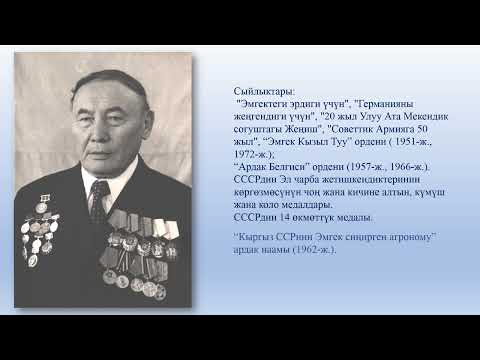
Azykov Kuliya Kazakbaevich
The name of Azykov Kuliya Kazakbaevich is inextricably linked with outstanding achievements in the field of agricultural science in Kyrgyzstan.
The name of Azykov Kuliya Kazakbaevich is inextricably linked with outstanding achievements in the field of agricultural science in Kyrgyzstan. The creation of a powerful material and technical base based on two small experimental stations near the city of Frunze, their transformation into a large Scientific Production Association with high scientific and production potential, and the development of a profitable economy — all this was the result of the activities of this outstanding scientist and the team he led.
From 1963 to 1989, Azykov Kuliya Kazakbaevich headed the Scientific Production Association 'Institute of Agriculture'. The major achievements of the institute during his leadership, its significant production potential, dozens of scientific discoveries and the training of highly qualified personnel were the result of his purposeful work and organizational talent.
Azykov Kuliya Kazakbaevich was born in 1911 in the village of Talaa-Bulak, Kochkor district. His pursuit of knowledge led him, after graduating from the Frunze Agricultural College, to the Central Asian Economic Institute. He then worked as a research associate at the Central Asian State Institute of Planning and Economics. In November 1939 he was drafted into the Red Army, and in December 1945 he returned to Kyrgyzstan.
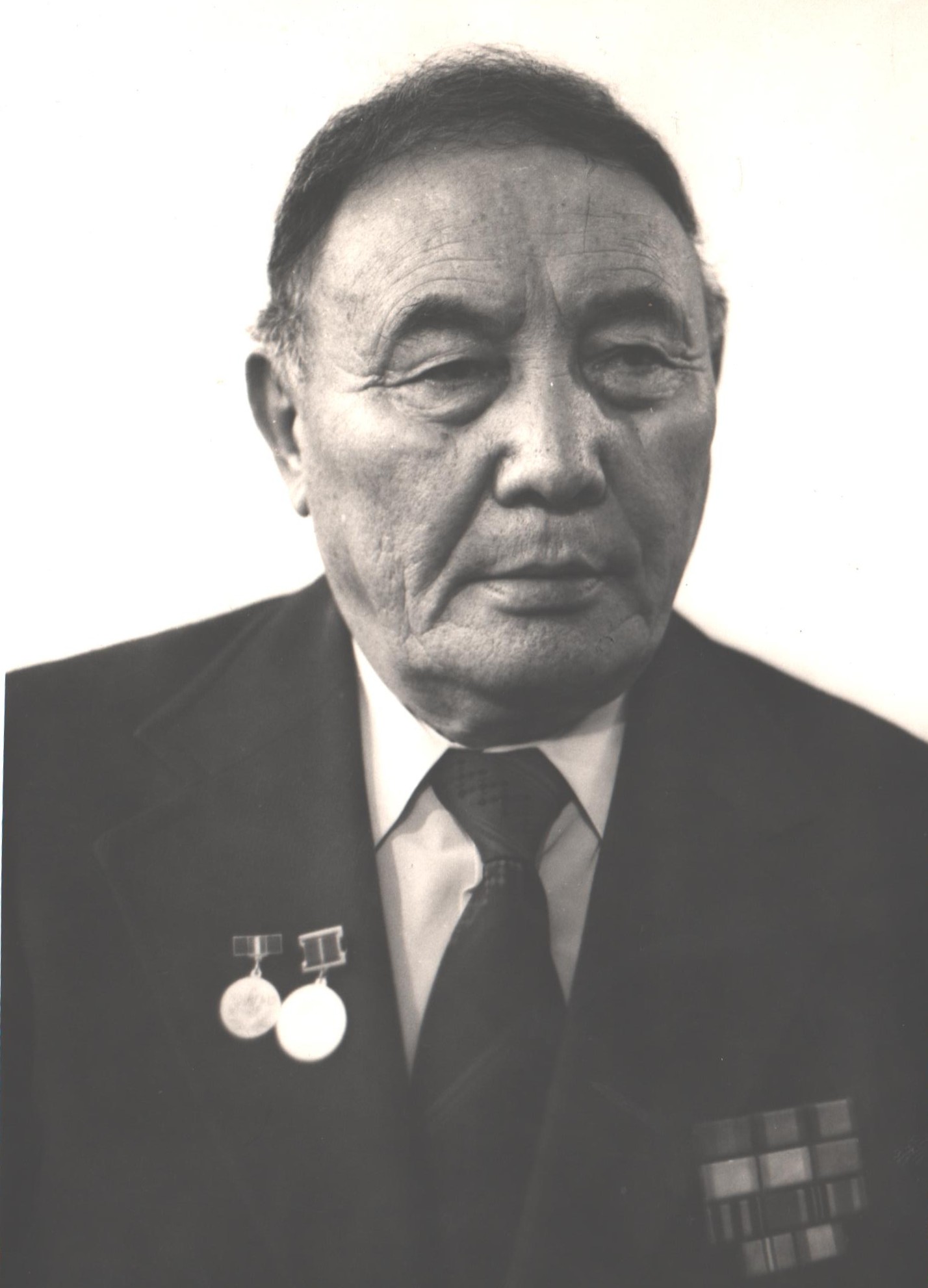
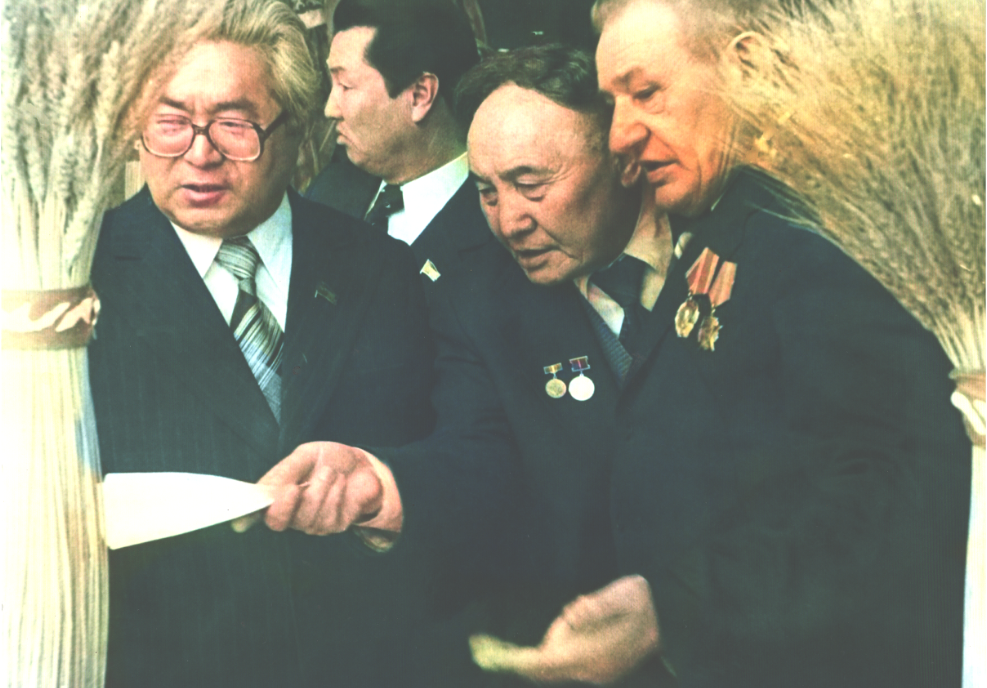
In 1956, the State Breeding Station for Grain Crops and the Republican Fruit and Vegetable Station were merged into a single research institute. While working in the Office of the Council of Ministers, as Deputy Minister of Agriculture and head of the Issyk-Kul Regional Agriculture Department, Azykov Kuliya Kazakbaevich was transferred to the Kyrgyz Research Institute of Agriculture in 1959. In 1960 he defended his candidate dissertation. In 1963 he was appointed director of the Research Institute of Agriculture.
Seeking to prove in practice that the right combination of science and production contributes to the development of agriculture, Azykov Kuliya Kazakbaevich organized the first breeding center in the history of Kyrgyzstan at the institute in 1971. The center was engaged not only in testing new varieties needed by agriculture, but also in breeding its own high-yield varieties.
In 1975, the institute was reorganized into a Scientific Production Association. Its composition included: the Research Institute of Agriculture, the Sugar Beet Experimental Station, the Osh and Issyk-Kul Experimental Stations, the Naryn and Kurshab support points, the experimental-production farm, the state farm named after the 50th anniversary of the USSR, the 'Kurgart' state farm, 11 fruit nursery state farms and other farms.
Under the leadership of General Director Azykov Kuliya Kazakbaevich, the once small institute became one of the largest scientific-production systems of the Soviet Union.
The association engaged in breeding new agricultural crop varieties, supplied collective and state farms with high-quality seeds of grain crops, potatoes, sugar beets, vegetables and fruit tree seedlings. It became a recognized center for developing and implementing advanced technologies for irrigation, fertilizer application, mechanized soil cultivation, as well as scientific methods of plant protection against pests and diseases.
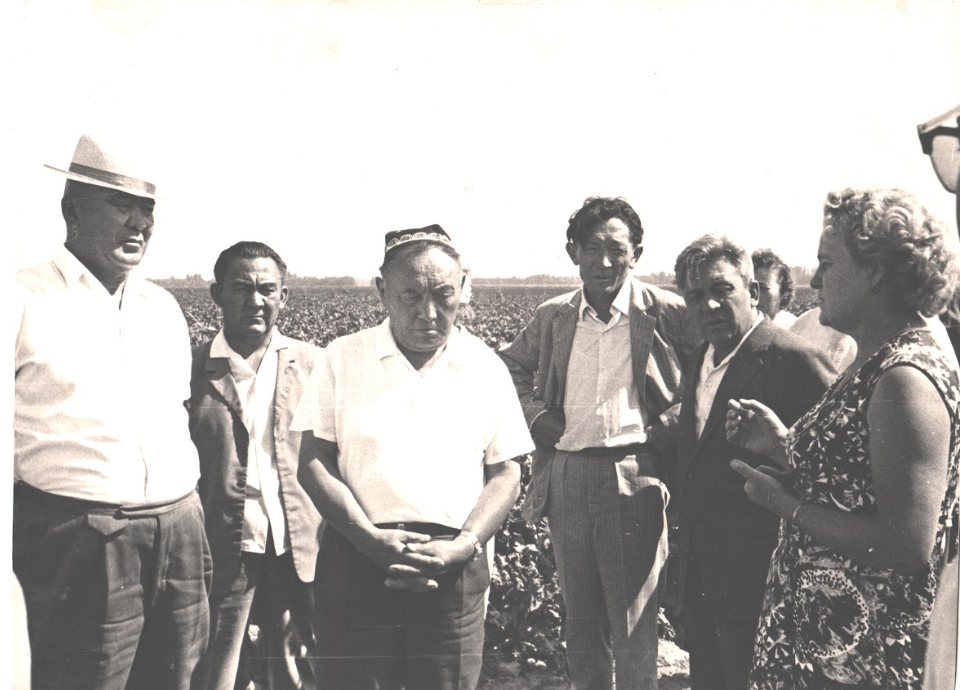
The association's activities were known not only in the USSR, but also beyond its borders. In 1980, under the leadership of Azykov Kuliya Kazakbaevich, the Scientific Production Association cultivated 140,000 hectares of land, of which 33,000 hectares were arable land, and 2,700 hectares were fruit orchards and vineyards. Dozens of new agricultural crop varieties were bred, high-yield varieties were tested, and adapted cultivation technologies were developed for various regions of Kyrgyzstan.
The association included 26 research departments and laboratories engaged in breeding grain crops, vegetables, potatoes, fruit crops and grapes. Research teams carried out large-scale work on creating new varieties and adapting promising varieties to the climatic conditions of Kyrgyzstan.
Each year, the association produced thousands of tons of elite barley and wheat seeds, high-reproduction corn seeds, potatoes, perennial grass seeds, vegetable crops and millions of fruit tree seedlings, supplying them to the republic's farms.
The viticulture laboratory achieved special success, thanks to which 18 new grape varieties were zoned. Agrotechnical techniques for growing grapes on difficult soils were developed, as well as methods to increase yields and improve product quality. The association's researchers received dozens of author certificates and published more than 200 scientific works of all-Union significance.
Well-known scientists worked at the institute: A. K. Filippovsky, A. I. Chernetsov, G. A. Kuzmin, Zh. A. Akimaliev, I. D. Kornev, N. G. Korneeva, N. M. Kuznetsov and many others. Under the leadership of Azykov Kuliya Kazakbaevich, the institute became the pride not only of the republic, but of the entire Soviet agricultural science.
The research institute employed 372 research staff, including 2 doctors of science and 80 candidates of science. During its operation, 2 doctoral and 62 candidate dissertations were successfully defended.
Great attention was paid to improving methods of increasing agricultural crop yields. The association's scientists developed effective agrotechnical techniques for growing winter wheat, barley, corn, sugar beet, as well as methods for the rational use of irrigation systems.
The varieties bred by the association, such as wheat “Osh T-1”, “Kyrgyzskaya-16”, “Kyrgyzskaya Jubileynaya”, “Kyrgyzskaya-100”, “Erythrospermum-80”, barley varieties “Nutans-45”, “Nutans-970”, “Naryn-27”, and corn hybrids “Chuy-47”, “Chuy-466” and “Chuy-62” received high marks for yield and quality not only in Kyrgyzstan, but also in other Soviet republics.
Advanced technologies for protecting fruit trees, growing vegetables and grapes developed by the association's scientific units were successfully applied in the republics of Central Asia, the Caucasus, Crimea and Ukraine.
In addition to scientific activities, the association was a large agricultural producer supplying the state with grain, sugar beet, meat and milk. The association's farms held thousands of heads of large and small cattle, pigs and horses. The annual volume of agricultural products exceeded 50 million som, and net profit was about 6 million som.
For outstanding achievements in science and agriculture, the Scientific Production Association led by Azykov Kuliya Kazakbaevich received high government awards of the USSR and the Kyrgyz SSR. Two of the association's employees were bestowed the title Hero of Socialist Labor, and dozens of staff were awarded orders and medals.
Azykov Kuliya Kazakbaevich himself was awarded medals “For the Victory over Germany”, “20 Years of Victory in the Great Patriotic War”, “For Labor Valor”, two Orders of the Red Star, the Order of the Badge of Honor, and was also awarded the title “Honored Agronomist of the Kyrgyz SSR” and the USSR State Prize.
In 1991, at the proposal of VASKhNIL, the Frunze city executive committee adopted a decision to install a memorial plaque to Azykov Kuliya Kazakbaevich on the building of the Kyrgyz Scientific Production Association.